Rani Lakshmibai: what the Rani of Jhansi teaches a 2026 girl
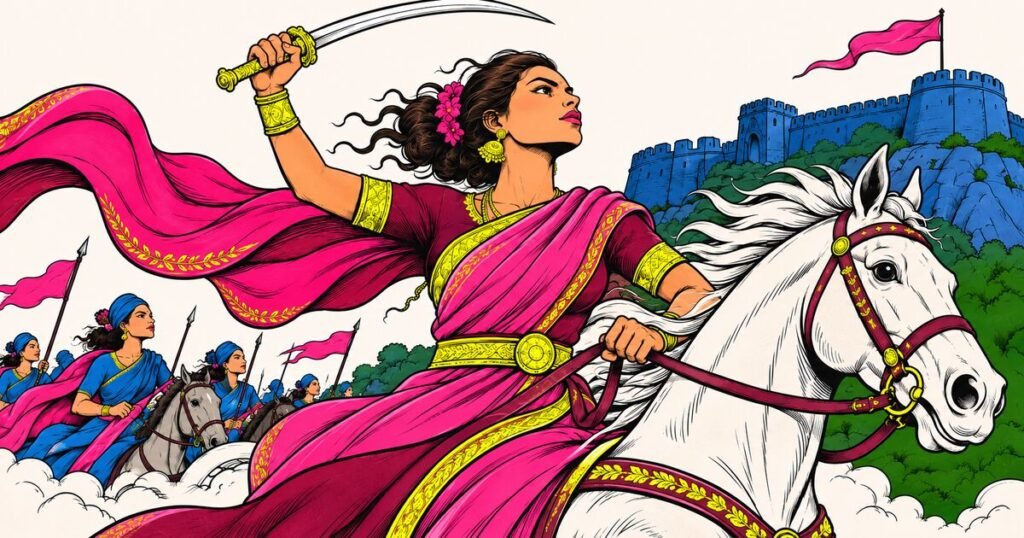
Picture this. You’re in your twenties, your husband has just died, you’ve adopted a son so the kingdom has an heir, and a British official writes back to say: no, we’re taking your state.
Most people would draft a polite appeal. The Rani of Jhansi drafted one, got rejected, and a few years later led her own troops on horseback.
Here is the Rani Lakshmibai story in five minutes: who she was, what happened in 1857, and what a girl in 2026 can take from a queen who refused to hand over her city.
Who was Rani Lakshmibai?
Rani Lakshmibai was the queen of Jhansi, a princely state in Bundelkhand, and one of the best-known leaders of the 1857 revolt against British rule. Born Manikarnika Tambe in Varanasi around 1828, she married Gangadhar Rao, the Maharaja of Jhansi, and fought the British until her death in June 1858.
The girl from Varanasi
Manikarnika, “Manu” at home, grew up in the household of the exiled Peshwa Baji Rao II at Bithoor, where she learned to ride and use weapons. That was unusual training for a girl in the 1830s. It turned out to be the most useful part of her education.
She married Gangadhar Rao and took the name Lakshmibai. The couple’s only son died in infancy.
The letter that took her kingdom
Shortly before he died in 1853, the Maharaja adopted a five-year-old boy, renamed Damodar Rao, as his heir.
The British refused to recognise him. Under Lord Dalhousie’s Doctrine of Lapse, a state whose ruler died without a natural heir could be annexed, and Jhansi was taken in 1854. Lakshmibai asked to be recognised as regent for her son. The request was turned down and she was given a pension instead.
Every woman who has been told “the decision has already been made” knows that feeling.
1857: the Rani takes charge
When the revolt of 1857 reached Jhansi, rebels took the fort and Lakshmibai was proclaimed regent for her son. She organised the defence and took command of rebel forces in the region.
In March 1858, General Hugh Rose’s army surrounded Jhansi. The fight was fierce. When the city fell, she escaped, and the popular account says she rode out with her son tied to her back.
She joined other rebel leaders, helped take Gwalior, and died fighting near Kotah-ki-Serai on 17 or 18 June 1858. She was dressed as a cavalry soldier.
The legend and the line
Two lines follow her everywhere:
- “Main apni Jhansi nahi doongi” (I will not give up my Jhansi), attributed to her when the annexation was announced.
- “The Indian Mutiny had produced but one man, and that man was a woman,” attributed to Hugh Rose, the general who fought her.
Both are attributed rather than recorded word for word, which matters less than what they show: her opponents remembered her as the most serious threat they faced.
Where the legend gets complicated
Historians still debate parts of her story, including her birth year, how much she planned the revolt and how much she was pulled into it. Some details, like the leap from the fort walls on horseback, come from popular accounts.
That doesn’t shrink her. It means the real woman is more interesting than the poster: a young widow making hard decisions with bad options and no time.
What a 2026 girl takes from this
- Put your objection in writing first. She petitioned before she fought.
- Learn the “unusual” skill. Riding lessons in the 1830s became her advantage in 1857.
- “No” from an authority is a decision, not a fact about your worth.
- Your story will be told by others. Be the one they can’t leave out.
FAQ
When is Rani Lakshmibai’s birth anniversary?
It’s widely marked on 19 November. Her birth year is disputed; most sources give around 1828.
What was the Doctrine of Lapse?
A British policy under Governor-General Lord Dalhousie that annexed princely states when a ruler died without a natural heir, ignoring adopted sons. Jhansi was annexed under it in 1854.
Where is Rani Lakshmibai’s memorial?
Her samadhi, a memorial at the place associated with her cremation, stands in Gwalior, close to where she died fighting in 1858.
Meet the other women on our wall in Herstory Hall, or read how Cleopatra did her own PR.
Read next
 Herstory
Unladylike Dictionary: 10 words they used against women
Virago, spinster, shrew and seven more. Where each word came from and why we are taking it back.
 Herstory
Cleopatra did her own PR
She learned the language her family never bothered with, staged her entrances and put her face on the money. A marketer reads the queen of Egypt.
 Gossip Corner
Wedding season survival guide for the single cousin
Shaadi kab, weight comments and the rishta ambush. Comebacks, outfit hacks and an exit plan for every function.